Shadow Dungeon Builds
Shadow Dungeon builds explained: 12 talent trees, 3 per class, unlimited skill points, 2,400 weapon-granted skills, sets and the Paragon layer after level 100.
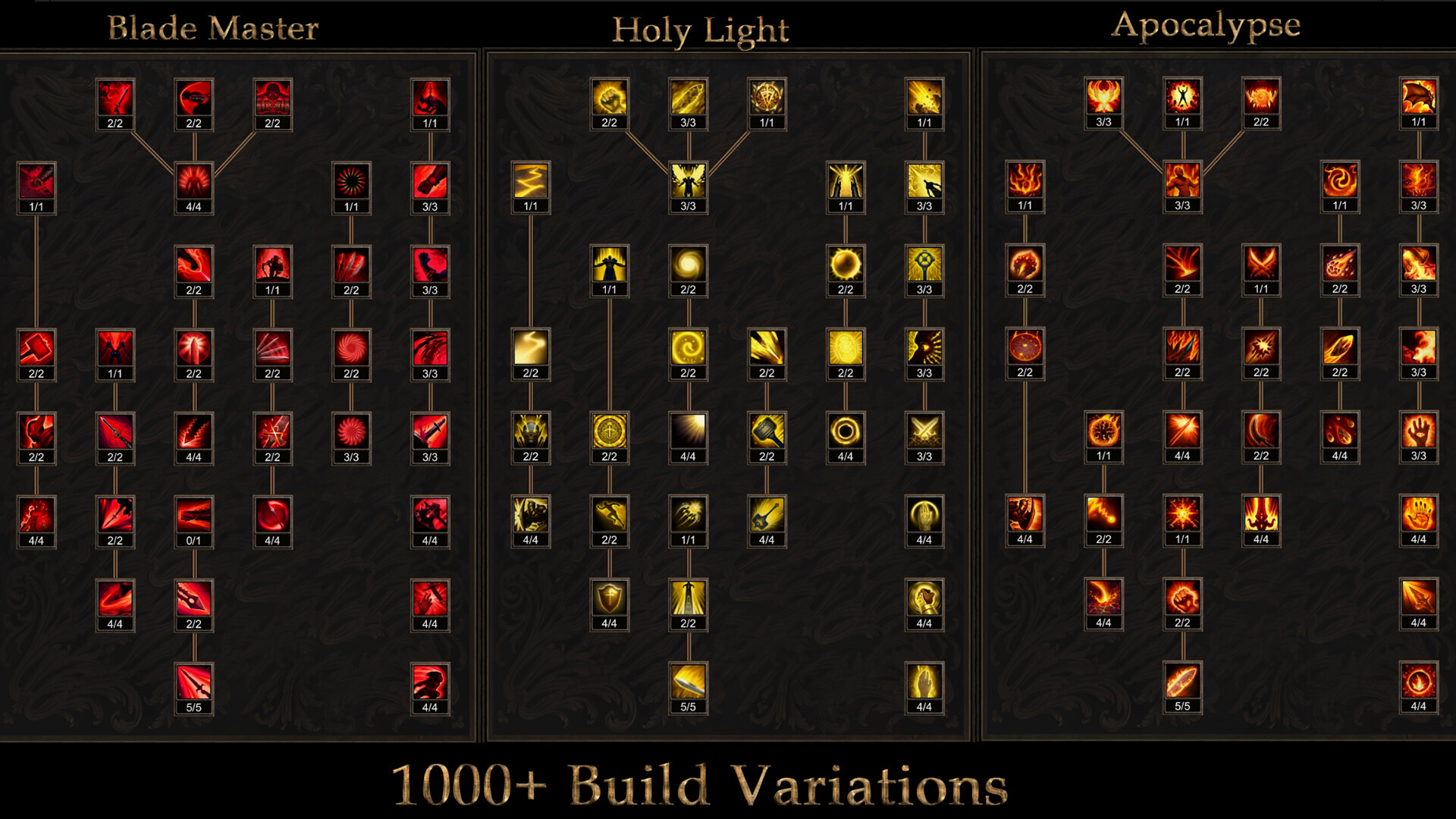
Shadow Dungeon builds work differently from most action RPGs, and the difference is printed on the store page: Unlimited Skill Points, enabling advanced hybrid builds in late-game progression. Scarcity is the usual engine of ARPG character building — you hoard points, fear mistakes, and hunt respecs. This game removes that scarcity on purpose, which moves the real question from "what do I choose" to "what do I combine". This page explains the systems that combination runs on, with the confirmed numbers and their sources.
For the class your build starts from, see classes; for the gear that feeds it, see drops; for the fights a finished build is tuned against, see bosses.
The three layers of a build
A character in Shadow Dungeon stacks three layers, and the official systems define each one. The first layer is your class's three talent trees — twelve trees across the four launch classes, sharing a pool of more than 370 skills. Tree names visible in OO Cat's official Steam screenshots are listed on the classes page; the Sorcerer's trio, for example, reads Hell Messenger, Storm Lord, and Archanist in the screenshot spelling.
The second layer is item-granted skills. The official content list states that more than half of all equipment includes additional skills that synergize with talents, which means a single drop can open a path your tree never offered — or change how an existing skill behaves. The launch notes quantify the layer: over 1,000 new weapon affixes in five categories (Basic, Special, Negative Effects, Skills, and Summoning Skills) and 2,400 new weapon-granted skills, with named types that show the design intent: Auras, Trap Launchers, Skill Conversions, Shields that Block Enemy Projectiles, Skill Combo Launchers, Summoned Creature Accessories, and Summoned Creature Attacks with Additional Skills.
The third layer arrives at the endgame. After the level-100 cap, Paragon Levels and the Paragon Talent Tree add attribute enhancements on top of everything else — the launch notes describe Paragon as further enhancing attributes, and the developer confirmed in a community reply that Paragon level is character-specific.
Unlimited skill points in practice
The official wording is careful: unlimited points "enable advanced hybrid builds in late-game progression". It does not say every tree should be half-filled during the campaign — early points still arrive one at a time, and early choices still shape your pacing through the seven chapters. What disappears is the permanent mistake. An InsertCoins review published on launch day reads the system as "by late progression you can eventually take everything", turning build anxiety into build curiosity; the reviewer's phrase for the new question — "not what to choose, what to combine" — is interpretation, but it matches the official framing of hybrids as a designed goal.
Respec is part of the loop. Launch-footage testing reported by fan guides shows the in-game Merchant selling a Forgetfulness Potion that resets talent skills, so a mid-campaign rebuild costs a potion rather than a character. Patch 1.0.1 on August 27, 2026 fixed cases where pinnacle talents did not clear correctly after a respec — a small note that confirms both the respec system and its pinnacle talents were live in 1.0.
One boundary deserves honesty: community videos from launch week describe hybrid combinations that reach across classes — a necromancer drawing on ranger passives, a mage mixing in paladin elements. Fan guides that verified the demo-era footage explicitly refuse to confirm cross-class tree access, and no official page describes it. Treat cross-class hybrid claims as player reports until OO Cat documents the system; within a class, though, hybridizing your three trees with item skills is exactly what the store advertises.
Sets, shrines, and the gear you build around
Beyond random affixes, the structured gear layer gives builds their chassis. Each of the four classes has 15 armor sets, and the launch notes add that most sets include affixes which alter skill forms — swapping sets can turn a single-target skill into an area one, or add behaviors the tree never had. Set-hunting across the campaign's 160+ maps and stages is therefore build-hunting in disguise.
The consumable layer is permanent and generous: the store lists 17 Blessing Shrines, various gems, buff potions, and rare permanent elixirs. The developer confirmed in a community reply that potions are unlimited, removing the usual potion-hoarding tension from tough fights. The Reforging, Enchanting & Enhancement system exists in the official content list, though its mechanics are not yet officially described — community videos float enhancement caps, but no official source confirms a number, so this page does not print one.
A built-in DPS Tester rounds out the toolset: the launch notes describe a training target that can attack the player, triggering counterattack skills so you can measure procs and defensive builds safely. For a game about combining systems, a sanctioned testing dummy is a quiet but important build tool.
The endgame your build points at
The campaign's roughly 30–50 hours exist to assemble the first two layers; the endgame exists to stress them. After the story, Greater Rifts open with four difficulties — Normal, Master, Nightmare, and Inferno — where higher tiers "provide higher chances of obtaining rare items, and weapons can also roll more affixes". That is the loop builds are ultimately tuned for: harder rifts, better gear, deeper synergies. The rift layer also carries exclusive rewards enumerated in the launch notes — 370 Talent Skill Runes, 6,800 Equipment Skill Runes, and 60 Attribute Runes, alongside Socketing Stones, Super Enhancement Stones, Essence Stones, Permanent Magic Stones, and the Golden Hammer and Divine Mirror.
The store also lists Mystic Dungeon Challenges as shipped content without describing them, so their role in the build loop is still officially blank; a Rune System remains on the roadmap as separate future content — do not confuse it with the runes Greater Rifts already drop.
How we will cover builds
This hub will index build write-ups per class and per tree route as they are tested against the current patch, with the version they were verified on printed on each page. Launch-week caution applies: several fan pages have published specific tree names and rotations that do not appear in OO Cat's published material, and this wiki will not repeat them. Until the first tested builds land, the confirmed skeleton is: pick a class whose trees you enjoy (best class helps), spend early points without fear, let item skills redirect the build, spend the Forgetfulness Potion when the plan changes, and push Greater Rifts once the Paragon layer opens.
Launch-week build mistakes the systems warn about
Official systems do not publish a meta, but they do warn against habits imported from other ARPGs. Hoarding points is the first: unlimited late-game points mean early thrift buys nothing — spending early improves the campaign's 30–50 hours for free. Ignoring item skills is the second: with more than half of all equipment carrying skills that synergize with talents, a modest-stat drop with the right granted skill can outweigh a higher-stat piece, and the 2,400 weapon-granted skills added in 1.0 exist precisely to be built around.
The third is ignoring sets. Fifteen armor sets per class, most with affixes that alter skill forms, mean a set swap is often a bigger build change than any tree point — the store's own set line makes form-changing affixes the headline, not the stats. And the fourth is treating the build as fixed: the Forgetfulness Potion respec and the Paragon layer at 100 both assume you will rebuild, probably more than once, on the way to the Greater Rift difficulties.
Two questions launch-week players ask that official pages do not answer: whether talent points can reach across classes (community videos claim it, verified fan guides decline to confirm it, no official page describes it), and what the enhancement cap is (a community video floats around plus 20; nothing official confirms it). Both stay open here until OO Cat documents them.
What is announced but not shipped
The store's planned-future list names four new classes — Assassin, Engineer, Barbarian, Warlock — plus a Mercenary System, Tower Defense Challenges, a Rune System, and Transmutation & Crafting. None has a date. The Rune System deserves its own caution: Greater Rifts already drop thousands of runes as 1.0 content, and the roadmap's Rune System is separate upcoming work, a distinction fan wikis tracking both are careful to keep. When any of it ships, the build layer gains new inputs and this page gains a new section with the patch number attached.
Frequently Asked Questions
Quick answers about Shadow Dungeon.
How do skill points work in Shadow Dungeon?
The store page advertises Unlimited Skill Points, enabling advanced hybrid builds in late-game progression. Early points still arrive gradually, but the late game removes the scarcity that punishes mistakes in other ARPGs.
Can you reset talent points?
Yes. Launch-footage guides report that the in-game Merchant sells a Forgetfulness Potion that resets talent skills. Patch 1.0.1 on August 27, 2026 also fixed cases where pinnacle talents did not clear correctly after a respec.
What makes a build strong in Shadow Dungeon?
Three official layers: your class's three talent trees, item-granted skills (more than half of all equipment carries skills that synergize with talents), and after level 100 the Paragon Talent Tree plus higher Greater Rift affixes.